
This is the view of a Google ad. Here in the first box place is the display path. The second one is the headline, and the third one is the description. From here the second and the third ones are really important because this is the place where we try to approach our customers with our goods.
If they approach with the headline and the description, then they come to the website for the details of our goods. That’s why in the first place this is a really important place where we should think many times before typing something. Because it will create the first impression about our goods. So you are welcome to our present article to learn how to write a great and perfect clickable headline and description.
Google Ads Copywriting
Google Ads copy is essentially the short, compelling sales pitch you use in your advertising to grab a user’s attention right when they are searching for a solution. While the ad’s settings handle the targeting, it’s the actual text—specifically the headlines and descriptions—that determines if someone clicks.
The headlines are arguably the most crucial component because they are the first and most prominent thing a user sees, often appearing as blue, clickable links.
They must immediately communicate value, solve a problem, and include relevant keywords to signal to the user, “This is what you’re looking for.” Similarly, the descriptions are vital because they offer the space to elaborate on the headline’s promise, provide critical details like pricing or unique selling propositions (USPs), and offer a final, strong call to action.
Together, a well-crafted headline and description function as an inseparable unit: the headline hooks the user, and the description reels them in, making them the most important things to meticulously consider for ad success.
To create a perfect and outstanding headline and description, we have to consider 5 different things:
- Keyword in ad copy (headline & description).
- Call to Action (CTA).
- Psychological Approaches To Find The Right Fit.
- Brand Term.
- Wrong Offer.
Let’s start with everything from here one by one.
Keyword in ad copy (headline & description)
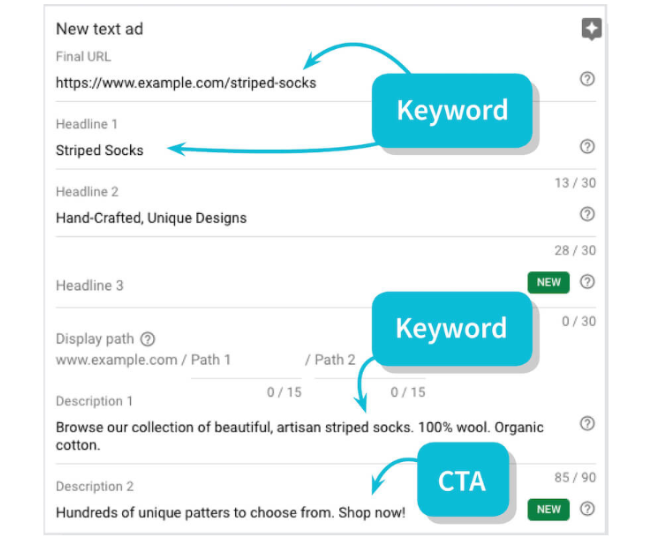
When we first start writing Google Ads text, the most important thing is to think about the keywords we chose. Why? Because those keywords are the words that make our ad show up. Every time a person searches using one of our keywords, our ad pops up in front of them.
That’s why the most crucial step is making sure you add your main keywords into both your headline and your description. Think of it this way: when people see your ad, they are looking for something specific. If the words they just typed into the search bar pop right back up in your ad copy, they feel an immediate connection. Seeing that familiar keyword gives them confidence and makes them feel much more certain that your business offers the exact solution they were searching for.
However, this doesn’t mean you should simply stuff your headline with every keyword you have. While including keywords is vital, your headline must still be meaningful and easy to read. It needs to make sense to the person searching and clearly communicate your value, not just look like a random list of terms. Always ensure that the keyword fits naturally and keeps the message strong.
In a single ad, we get to be very creative! We can provide up to 15 different headlines (each limited to 30 characters) and four different descriptions (each with a 90-character limit). If you find yourself thinking, “I have way more than 15 keywords; how can I use them all?” don’t worry. Your keywords are likely all about the same main topic and are closely related.
If you create those 15 headlines and four descriptions perfectly—making sure to cover all the main ideas and closely related keywords—Google’s system will take care of the rest. It smartly mixes and matches the different pieces to show the best possible ad for every specific search. These 15 headlines and four descriptions are more than enough to handle your product or service perfectly.
Call to Action (CTA)
After you’ve done the hard work of perfectly weaving your keywords into your headlines and descriptions, there is one more iconic way to make your ad copy even stronger and more attractive to your potential customers: using a “Call To Action” (CTA).
We can effectively use a Call To Action (CTA) in both our headlines and descriptions to give our potential customers a gentle but firm push. However, it is essential that the CTA remains meaningful. A CTA is your ad’s instruction manual; it tells the user exactly what to expect when they click. Instead of just saying a vague phrase like “Learn More,” a strong CTA uses action words, such as “Shop Now,” “Get A Quote,” or “Book Your Seat Today.”
When users clearly know the goal of the click, they feel much more confident and are significantly more likely to engage. A well-placed CTA doesn’t just attract traffic—it efficiently guides that traffic toward taking the next step with your business.
In your headline and description you can use this CTA.
- Shop Now
- Buy Now
- Get Quote
- Learn More
- Discover
- Sign Up
- Order now
Psychological Approaches To Find The Right Fit
Psychological approaches will be a great thing if we add this in our headline and description. But yes, it can be hard to maintain for every business. But you can use it if the under options are addable with your business.
- Features: Highlighting the physical or intangible aspects of the product/service. (Memory foam)—What
- Benefits: Calling out the positive outcomes the visitor will have from the product/service. (More restful sleep) – Why
- Problem: Focus on the actual issue at hand to relate to the problem the visitor is trying to solve. (Tired of Wasting Time?)
- Solution: Focus on the solution to the problem the visitor is facing. (Save Time)
If it’s possible, always try to weave these compelling ideas—like features, benefits, and testimonials—into your headlines and descriptions. But remember the golden rule: everything you write must still align with your selected keywords.
The final step is finding the perfect balance: make sure your headlines and descriptions use the keywords your audience is searching for while also highlighting a fantastic benefit, solving a problem, or including a powerful call to action. When you achieve this, you create an ad that is both relevant (for Google and the searcher) and incredibly attractive (for the searcher).
Ultimately, this means you need to create a headline or description that uses the search term or selected keyword but also builds a psychological approach.
Otherwise, you can avoid it and go through with the keyword and CTA for an ideal headline and description.
Brand Term
Including your brand name in your headlines or descriptions can be a huge asset, but only if you are already a well-known business. For recognizable brands, seeing their name pop up instantly builds trust and familiarity for the person searching. When a well-known business uses its name in the ad, it often translates into better results because the traffic is already comfortable with the brand.
Before you use it, however, you must first understand how your audience actually searches for your business. Are they searching for your name specifically? Are they using your name plus a product? By confirming how your traffic interacts with your brand name as a search term, you can strategically place it in your ad copy to maximize its powerful effect.
Wrong Offer
Crucially, never write anything in your headline or description that you don’t actually offer at the time of the click. For example, if you claim a “30% discount” in your ad copy, but that deal isn’t live on your landing page, users will immediately feel misled and leave.
This not only wastes your ad spend but severely damages trust. The ad copy is your promise: only write about the products, offers, features, and pricing that are genuinely available and active on your website. Honesty ensures a good user experience, which ultimately leads to better conversion rates and happy customers.
To create truly successful ad copy, the final task is to craft headlines and descriptions that are perfectly balanced for your selected keywords. These key components must successfully bring together all three crucial elements: they need to contain the keywords for relevance, include a strong Call to Action (CTA) to drive clicks, and employ a psychological approach (like highlighting benefits or solving a problem) to make the ad highly compelling.
When you nail this three-part combination, your ad copy stops being just text and becomes a powerful, automated sales pitch.
Ads Copy with AI
In today’s market, we have access to many AI tools that can help perfect our ad copy and speed up the creative process. To get the best help from these tools, you need to start by giving the AI your selected keywords and as much information as possible about your product or service.
With this data, the AI can generate many different ideas for headlines and descriptions. From those ideas, your job is to carefully select the perfect headline and description, the ones that are truly good at presenting your business while also perfectly matching the user’s search term. AI is a great source of ideas, but the final, strategic choice still needs to be yours.
AI Prompt:
You are a Google Ads copywriter expert specializing in creating high-conversion, emotionally engaging ad creatives.
Your task is to generate 15 compelling headlines (maximum 30 characters each) and 4 powerful descriptions (maximum 90 characters each) for a Google Search Ad campaign.
The copy must be conversion-driven, emotionally appealing, and keyword-rich, while strictly adhering to Google Ads policies. Focus on incorporating the target keywords naturally.
Target Keywords: [buy face wash online bangladesh, best cleanser price in bd, acne cream offer, moisturizer near me]
Quick Guidelines:
- Include target keywords naturally in the headlines.
- Use strong CTAs like “Shop Now,” “Order Today,” “Get Offer,” “Buy Online,” etc.
- Highlight benefits—e.g., clear skin, fast delivery, trusted brand, discount, natural ingredients.
- Avoid repetition across headlines.
- Descriptions should be concise and persuasive and include emotional triggers, benefits, and a CTA.
- Optimize for high CTR and BOFU (purchase-ready) intent.
- Maintain a tone suitable for [skincare].