
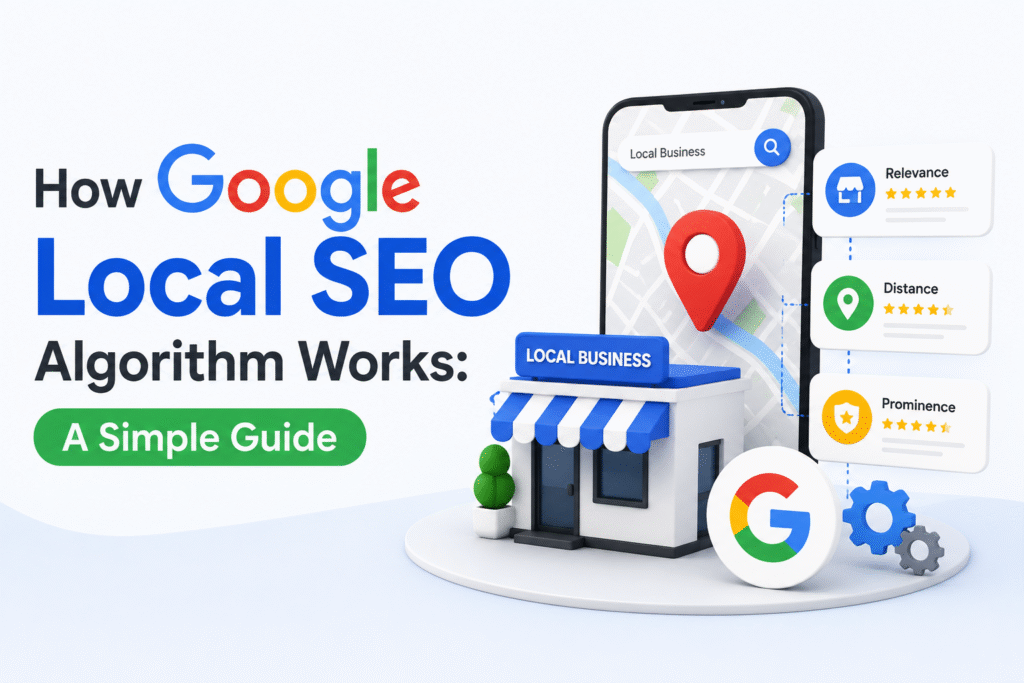
Local SEO is very important for any local business or service provider. Through this, a business owner can easily reach the targeted customers of his specific area.
Through this Local SEO series, we will cover each of its topics step by step. We will tell you in detail how you can improve your local SEO and increase business promotion.
To do well in local SEO, you first need to know its ranking factors. If you understand these factors clearly, it will be much easier to make your next business plan.
So, let’s know how the local SEO algorithm works. But before that, let’s learn a little about the ‘Three Pack’ of local SEO.
Local SEO Three Pack or Map Pack
The first three business profiles that appear when you search for a local service or business on Google are called the Local SEO Three-Pack. It is also sometimes called the ‘Map Pack.’
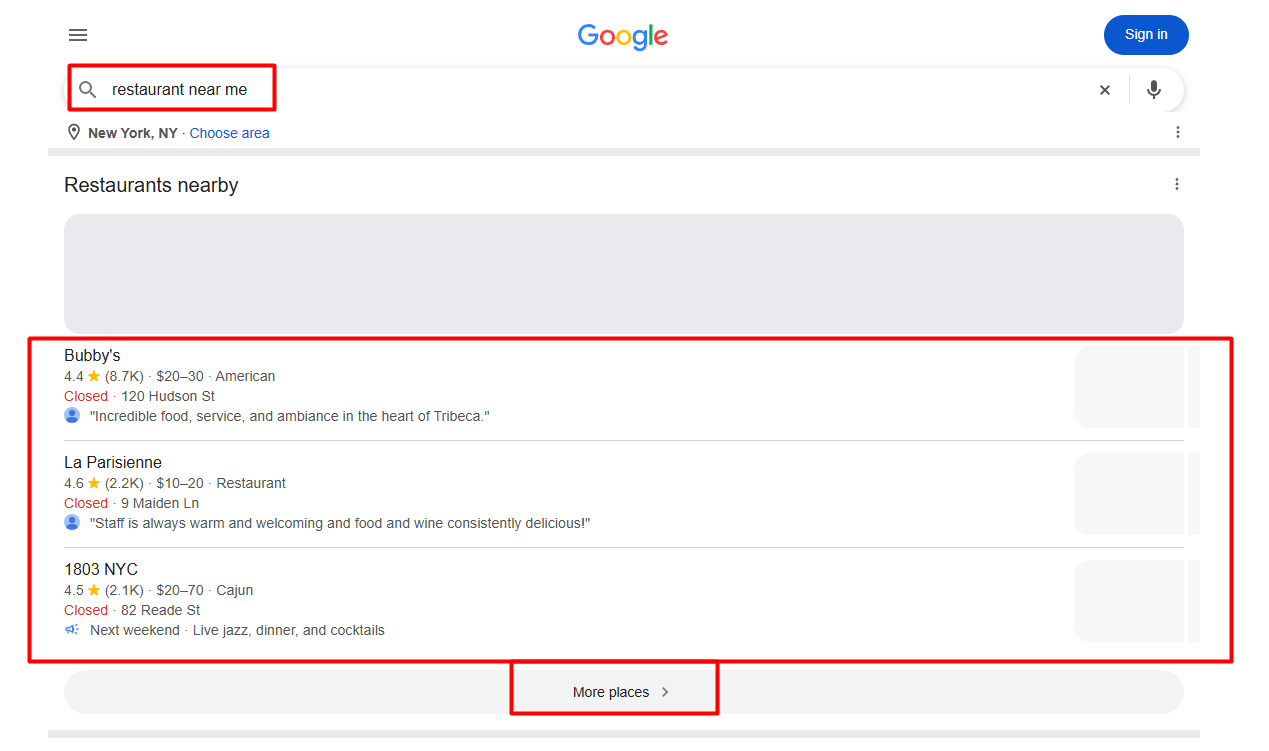
As you can see in this image. After searching for “restaurants near me,” the names of three businesses appear at the top of the results. This is what we call the three-pack or map pack.
The main goal of all local businesses or service providers is to be in these first three places. Because if you can stay in these first three places, you have a much higher chance of getting a sale or booking than others.
So in today’s article, we will discuss the local SEO algorithm. We will know, based on which factors Google decides who will get a place in this three-pack.
Local SEO Algorithm
We all know that Google values search customers more than businesses or service providers.
A customer will use Google only when they see that Google’s results match their search query very well.
For this reason, Google always tries to give the best results to the user. Google not only shows relevant information but also suggests which of the relevant information is the best.
Which local business Google will show first after the user’s search is mainly determined based on three factors:
- Relevance
- Proximity
- Prominence
So, let’s learn about these topics in detail one by one.
Relevance in the Local SEO Algorithm
Suppose you go to two libraries. You are looking for a book on flower gardening.
The first librarian gives you a general gardening book. That book covers everything you need to know about gardening.
But the second librarian gives you a book specifically on ‘flower gardening.’
Now whose work do you like better? The first librarian’s or the second librarian’s? Of course, the second librarian’s.
Google also tries to work exactly like this second librarian to maintain the relevance.
I hope you understand this example. Now, a real example will make things clearer.
Suppose a user searches Google for “emergency dentist near me.”
Now, you have optimized your Google Business Profile (GMB) only for the keyword “dentist.” But your competitor has optimized his profile directly for the keyword “emergency dentist.”
In this case, Google will show your competitor’s business before your business. Because his profile is more relevant to the user’s search.
But it is not enough to have the keyword alone. Google checks the primary and secondary categories of your business profile to confirm this relevance.
For example, if your primary category is “Dentist” and the secondary category is “Emergency dental service,” then your relevance to Google will increase a lot.
In simple terms, Google compares your and your competitor’s business profiles to the keywords that users type into Google. Google shows the business of the person whose profile is most relevant to that keyword first.
Proximity in the local SEO algorithm
Google found some businesses by checking the relevance of the user’s search query. But the more relevant it is, the higher the profile will be; it’s not like that.
In the next step, Google will check the proximity or distance. That is, how close a business or service is to the location of the customer who is searching.
Suppose your dental office is very close to the searched location, at most half a kilometer. But your competitor’s office is very far away.
In this situation, your business profile will come first in Google’s search results. No matter how big or famous your competitor is, you will be ahead due to the short distance at the moment.
Because at this stage, Google thinks that the customer needs a dentist very quickly. So, Google gives more priority to the one who is closest.
In simple terms, this is Google’s Proximity Checking. Proximity or distance is the biggest factor in local SEO. However, there is not much we can do directly in this area. Because even if we want to, we will not be able to take our shop or business to the customer’s home.
But yes, there are some technical things that can be done here too, which you will see in our other article.
So, let’s talk about our last point, prominence.
Prominence in the Local SEO algorithm
Google has already checked the relevance and proximity of your business. Now it is the turn of Google to do its final check, which is prominence or popularity.
In this step, Google sees how your business or service is being discussed online. Because Google always wants to suggest the best and most reliable locations to its users.
Suppose when someone searches for “dentist,” Google sees that you are completely new in the market. There is not much discussion about your dental chamber online or elsewhere.
On the other hand, your competitor has been popular for a long time; people are talking about him in different places, and his profile has good reviews.
In this situation, Google will suggest your competitor’s profile first in the search results. In simple words, this is Google’s prominence or popularity factor.
So
So, after receiving the search query, Google first starts checking which local businesses are relevant to that search term.
Then Google checks which of those relevant businesses is closest to the customer (proximity). And finally Google looks at which of them has the best online performance or popularity (prominence).
It is by following these rules that Google decides who will get a place in the Three-Pack or Map Pack of Local SEO after a particular search and who will not.
But
However, this rule does not always work the same way. Because Google sometimes gives more priority to proximity (distance) and sometimes gives more priority to prominence (popularity).
When Google understands that the customer needs an emergency or urgent service right now, they give the highest priority to proximity.
But when it is seen that the matter is not an emergency and people have enough time or they can travel a little distance if necessary, then prominence or popularity takes precedence.
For example, a small example will make the reader understand more easily:
- If someone searches by typing “towing service near me,” Google will give priority to proximity or distance. Because the customer is in danger on the road, he needs help quickly.
- Again, if someone searches by typing “best buffet restaurant,” Google will give priority to prominence or reputation. Because the customer is willing to go a little far for good food.
So it’s clear that Google uses these three things to show local search results. But depending on the user’s search intent, Google determines which of these three to prioritize when.
Finish line of this article
Hopefully, this whole topic of local SEO algorithms is now clear to you. In the rest of our articles in this series, we discuss how you can practically optimize these factors. Keep an eye on our page!