Google Ads has become one of the most in-demand advertising platforms, trusted by businesses and advertisers worldwide. With Google being the go-to search engine for users seeking solutions, advertisers have a unique opportunity to connect with potential customers exactly when they need it.
But merely increasing ad traffic is insufficient. To guarantee the highest conversion rate, it is our responsibility as advertisers to strategically direct that traffic. The good news is that Google already collects useful user data. Effective use of this data will enable us to develop customized, targeted campaigns that produce outstanding outcomes.
Knowing Google Ads’ bidding strategy is one of the most important aspects of this process. Selecting the appropriate bidding strategy is crucial because making a mistake could cost you important opportunities. Optimizing your bidding process is essential for success in order to make sure you reach the right audience at the right time.
What is the bidding process?
Bidding is the process through which you tell Google how much you’re willing to pay, and sometimes with the bidding, Google knows what our exact target is and what we are trying to get here. Then with this bidding, Google tries to optimize the ad delivery to reach the best audience for achieving that goal.
That’s why it’s a really urgent step to pick it perfectly. Others wish it will harm you financially, and you are not going to get the perfect traffic amount. Let’s explore the bidding system one by one.
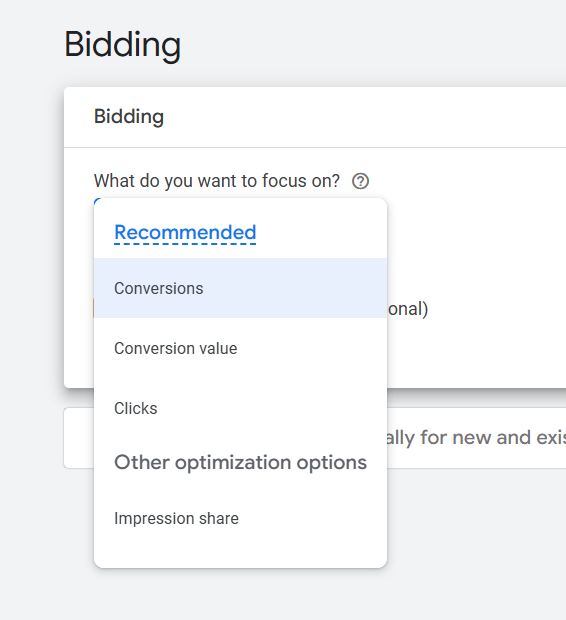
But here one interesting thing is that we will not be able to get all these options the first time when we create the campaign. So for some of these options, we have to go to the setting.
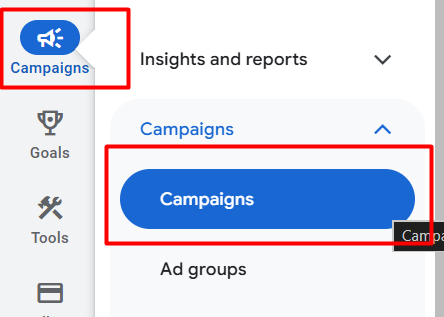
To get all these options, we will have to go to the campaigns section.
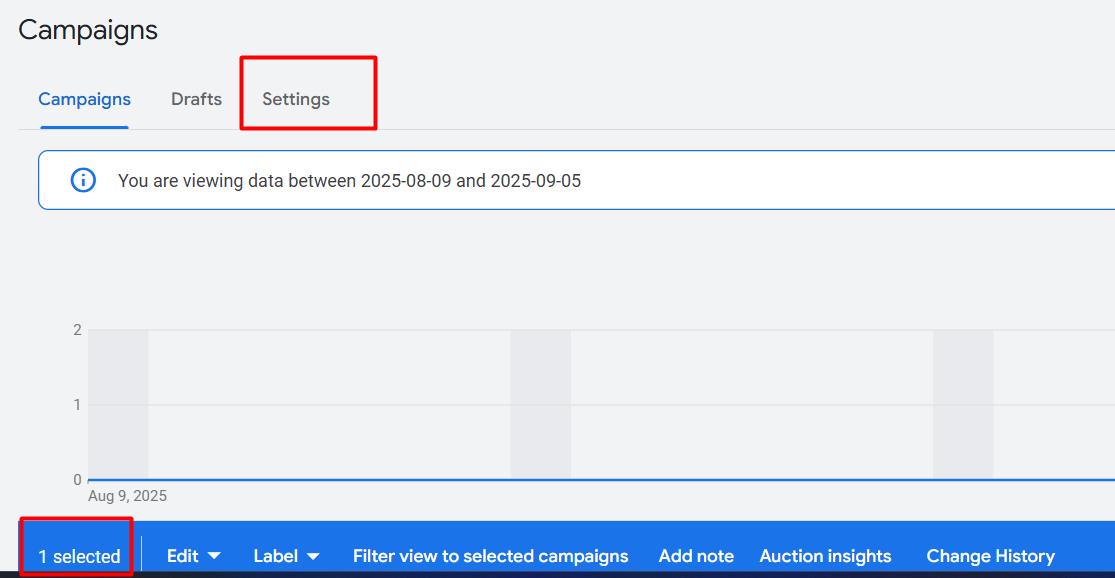
Then, from the campaign list, select one campaign and click on the setting option.
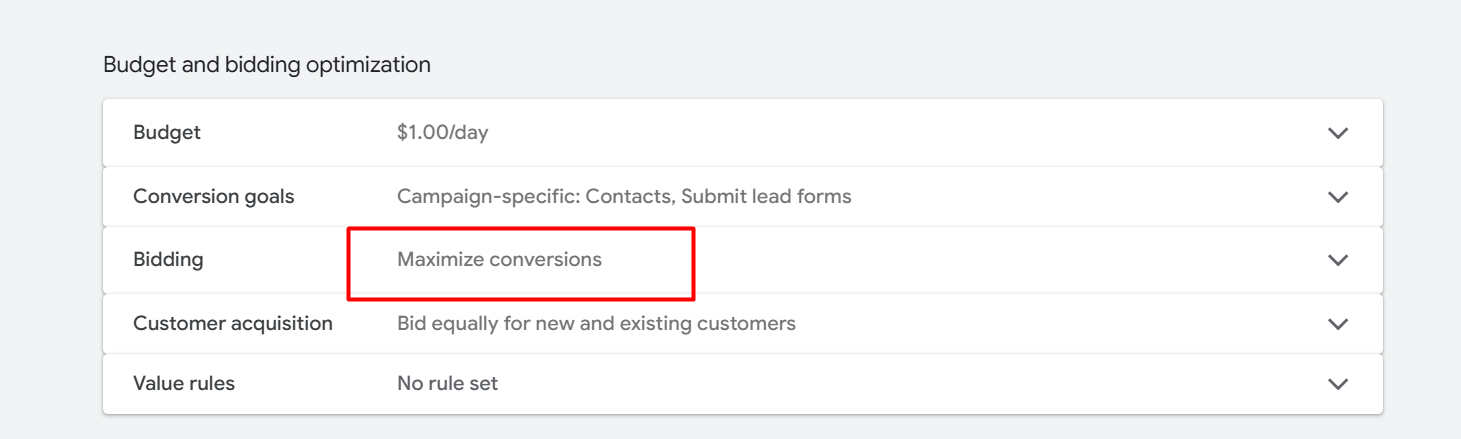
Now here is our need. Let’s go and check everything one by one.
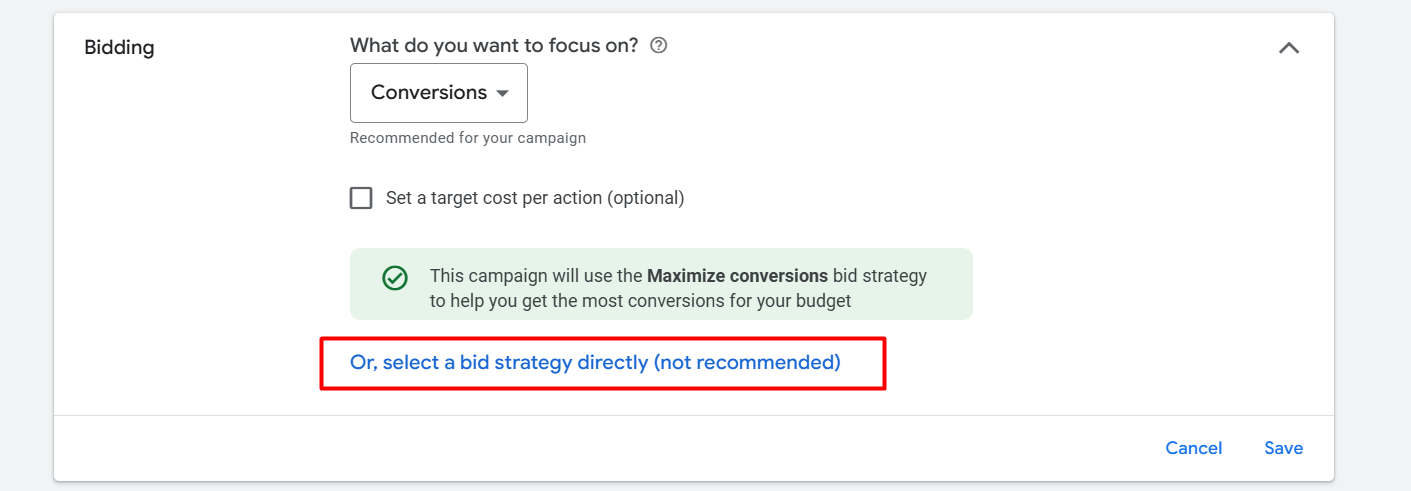
Click here for all the details on the next bidding strategy.
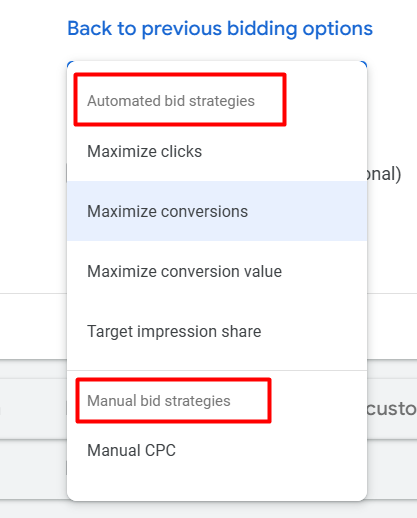
Here you can see Bidding has two different types.
- Manual Bid Strategies
- Automated Bid Strategies
Let’s start with the “Manual Bid Strategies.”
Manual Bid Strategies
- Manual CPC
Manual CPC: Manual CPC is a process that you can use to set up your cost per click (CPC) manually by your hand.
Manual CPC is frequently safer when launching a new Google Ads campaign. You can prevent overspending while collecting data because you have complete control over your bids and budget. You can still set a Max CPC to limit the amount you pay per click, but Google automatically modifies bids to get you as many clicks as possible when you use Maximize Clicks.
However, because Google doesn’t have a complete picture of what will work best, Maximize Clicks might still quickly blow your budget if you don’t have enough data. Even if they don’t use over CPC.
Google wants to maximize clicks while staying within your budget. Where it believes it can get the most clicks is determined by machine learning. Google may occasionally bid more than your maximum cost per click (CPC) for specific clicks if it believes that location will generate more traffic.
That’s why always for the first campaign we should use manual CPC. Especially at the time when you think our ads account doesn’t have enough data about our business. Without data, maximize click will not be able to give you the exact perfect traffic. Because Maximize Clicks works with real-time data to optimize the campaign.
But at the manual CPC, we can control the CPC, and over time we can optimize our campaign by optimizing the CPC for keywords one by one. We can look over the keywords, and we can increase the budget for some keywords, and for some keywords, we can decrease it. Because it’s really important to create a control over the keyword; otherwise, it will harm you by losing your money.
And on the journey, your Google Ads account will collect data through your Google conversion tracking. So once you’ve gathered data, automated bidding strategies like Maximize Clicks will perform more effectively.
Automated Bid Strategies
With the help of automated bid strategies, Google can automatically adjust your bids to meet objectives like increasing clicks or conversions. Google uses machine learning to instantly modify bids according to budget and competition. Although it saves time, you have less control over each bid.
All types of automated bid strategies:
- Maximize Click
- Maximize Conversion
- Maximize Conversion Value
- Target Impression Share
- Target ROS
- Target CPA
- Viewable Impression or Viewable CPM
- Target CPV (Cost Per View)
Maximize Clicks: If you select the maximum click bidding, then Google will optimize your ads to get more and more clicks as per your campaign budget.
But here in this bidding, if you want to get a good enough traffic amount, then you will have to have real-time data before selecting this bidding system. Otherwise it will not work the way it should.
Maximize Conversion: After using the maximum conversion, your Google Ads will work to get more and more conversions.
But to get the great result, you have to complete your Google Ads conversion tracking. And by the way, you have to gather data in your account. With this data, Google will be able to understand your business, and then Google will find this type of person to help you get the targeted conversion. But don’t forget, in your first campaign, you shouldn’t use it because you don’t have anything to provide Google. Also for this campaign you have a large budget.
Maximize Conversion Value: With this bidding process we said to Google, “Please, brother, with this campaign, please help us to increase our conversion value.”
This type of bidding is really great for e-commerce businesses. With this bidding, Google optimizes our campaign and tries to give us a big amount of conversion. Because Google already has the data about those people who are really able to make this type of conversion.
Definitely you are not able to use this bidding process if you don’t have enough data from the beginning. So don’t forget to create your enhanced Google Ads conversion tracking setup. Otherwise, if you select this bidding, you will lose your money.
Target Impression Share: Target Impression Share is a Google Ads automated bidding technique that focuses on a particular spot on the search results page, like the top of the page or anyplace on the page, to increase the visibility of your ad. Target Impression Share seeks to reach a target share of impressions based on your selected percentage, in contrast to other strategies that optimize for clicks or conversions. When visibility is more important than immediate performance indicators, this approach is perfect.
The first step is to establish a target impression share goal, such as “I want my ad to appear at the top of the page 70% of the time.” After that, Google will automatically modify your bids to make sure your ad reaches that impression share target. The objective is to make your advertisement more visible in the desired location so that it is more likely to show up there on a regular basis.
In a simple way, if I explain this, it’s like you are saying to Google, “That is my selected keyword; if searched in Google 100 times, my ads should be in there at least 70 times.”
Also, in the time you can select on a page where your ads should be.
- Absolute top of the page
- Top of the page
- Anywhere of the page
Target ROS: Target ROAS (Return on Ad Spend) is a Google Ads bidding technique that increases ad revenue. Target ROAS ensures that you’re getting a good return on your ad investment rather than just concentrating on obtaining clicks or conversions.
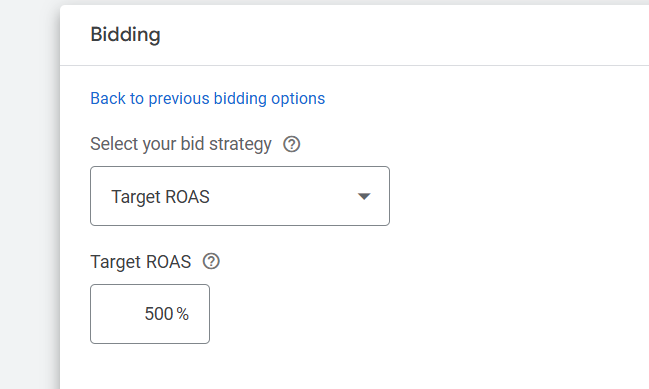
You decide how much you want to make for each dollar you spend. For instance, you set a 500% ROAS goal if you want to earn $5 for every $1 spent. Google then modifies your bids to assist you in reaching that objective, attempting to maximize revenue while adhering to your spending plan.
To put it simply:
- Target ROAS assists you in ensuring that you are earning money from clicks rather than just receiving them.
- Google automatically adjusts your bids using intelligent technology in an effort to maximize your return on investment.
Target ROAS is most effective once you’ve already generated some sales through other methods earlier in the funnel. After those initial conversions, Target ROAS can help optimize your ad spend for maximum profitability by focusing on generating more sales at the right return. Otherwise, the bidding will not perform perfectly for your campaign. So please don’t use it in the earlier time of your campaigns.
Target CPA: This is an automated bid through which you are saying to Google how much you’re willing to pay for each conversion.
But before using this bidding process, Google suggests getting at least 15-50 unique conversions in the last 28-30-day period.
If you want total control over your bids or ad scheduling, Target CPA might not be the best option. You cannot manually control the bids for specific keywords or the timing of your ads when using Target CPA because Google automatically modifies bids based on its algorithms.
Target CPA might not provide you with the degree of control you desire if you want to make precise changes depending on the time of day, user behavior, or keyword performance.
Viewable Impression or Viewable CPM: The goal of Google Ads’ Viewable Impression (also known as Viewable CPM) bidding strategy is to pay for impressions that users actually see.
Viewable CPM only bills you when your ad is truly visible to the user (as determined by Google’s viewability standards), as opposed to standard CPM (Cost Per Thousand Impressions), which charges you for each 1,000 impressions served.
It guarantees that you’re spending money on impressions that are more likely to be seen.
Target CPV (Cost Per View): This is a Google Ads bidding technique that is mostly applied to video campaigns (such as YouTube ads). Target CPV allows you to specify the highest price you are prepared to pay for each video ad view.
After that, Google automatically modifies your bids to help you reach your desired CPV and get as many views as you can while remaining within your budget.
Best Google Ads Bidding Strategies to Maximize Your Campaign Results
- Brand Awareness & Consideration: Getting your ad in front of as many people as possible is usually the main focus if your main objective is to raise brand awareness and consideration. The following bidding techniques are suggested for these goals:
- Target Impression Share
- vCPM (Viewable CPM)
- Website Traffic: If increasing website traffic is the aim, you should concentrate on increasing website clicks. The suggested bidding techniques for this objective are as follows:
- Manual CPC
- Maximize Clicks
- Sales: Driving conversions and sales while making sure you’re getting a good return on your ad spend becomes the main focus of eCommerce campaigns. The following tactics work well for achieving sales goals:
- Maximize Conversions
- Maximize Conversion Value
- Target CPA
- Target ROAS (Return on Ad Spend)
- Leads: Instead of making direct sales, the aim of lead generation campaigns is to collect valuable leads (such as sign-ups, inquiries, etc.). The most effective bidding techniques for achieving this objective are
- Manual CPC
- Maximize Conversions
- Target CPA
Here already we explain all the Google bidding process to you. To get the perfect result with the bidding process, the key point is always that you have to use the perfect bidding for the perfect campaign.
After selecting the perfect bidding for the perfect campaign, you have to follow a structured way one by one. Because here in the automated bidding process, if you don’t follow the structure, then your account will not be ready to use for the next bidding. Because without the real-time data, the automated bidding process does not work perfectly.