
When we think of running Google Ads, it is very important to create keywords and ad copy according to the right intent to create a perfect campaign. Especially when you want to run search ads, the importance of keywords increases a lot.
While doing keyword research, we often see that the brand names of our competitors are performing quite well as keywords. Many times, due to various business strategies, we need to use these competitor brand names.
In today’s article, we will discuss in detail how you can use the names of competitors in the right way within the keywords and ad copy in your Google Ads campaign.
Main Question to Our Minds
Whenever we start thinking about using competitors’ brand names as keywords, two different questions come to mind:
The first question is, can we try to bid on competitors’ brand names as keywords in our campaigns? I mean, can we put a competitor’s brand name in the keyword list?
The second question is, Is it possible to use competitors’ brand names directly within our Google ad copy or in the heading? And if we can, what is the right way to do it?
First Question Answer
If I answer your first question directly, the answer will be yes, you can definitely bid on your competitors’ brand names, no problem.
This means I want to say that you can add your competitors’ company names to your Google Ads campaign’s keyword list without any hesitation. Doing so will not cause any problems with your account or ads. Google allows these things, so you can safely use them in your keyword list.
Second Question Answer
However, the answer to your second question is a little different. Yes, you can use competitors’ names in your ad copy, but it depends entirely on some specific conditions or issues. You need to know exactly when and how you can use these names.
Because, if you use another brand’s name directly in your ad without following the correct rules, that company can complain to Google against you. As a result, your ad copy may be canceled or suspended. And if you make this mistake repeatedly, there is a risk of your entire Google Ads account being closed.
But there is no reason to worry! In today’s article, we will discuss the answers to these two questions in depth and find out which is the most correct and safe way to use competitors’ names in keywords and ad copy.
Use a competitor’s name in the keyword list.
You can usually use competitors’ brand names in your keyword list in two specific cases, which can be very profitable for your business:
- When your industry is very competitive: If your business is in a sector where there is a lot of competition—such aseducation, software (SaaS) or any such business—then to survive there, it is not enough to use keywords for your own services. Rather, it is very important for your ad to appear in front of people when they are searching for your competitors’ names. This gives you the opportunity to attract the attention of your potential customers.
- To increase brand awareness: If you are new to the market and want people to know your name along with your competitor’s brands, this is a great strategy. Setting keywords based on the brand names of your competitors can create brand awareness for your brand very quickly.
You must have to accept
But before using this strategy, you must keep one thing in mind. When you run ads on your competitors’ brand names, your CPC (Cost Per Click) or click cost can be much higher than that of normal keywords.
The main reason for this is ‘relevancy.’ The competitor’s brand name that you are using as a keyword does not have any direct match with your ad copy or landing page. Since your ad copy and landing page do not include your competitor’s name, Google reduces the quality score of your keyword. And due to the low quality score, your advertising cost or CPC increases a lot.
Therefore, the plan of using competitors’ brand names as keywords should be your last option. Because it is not the case that you will get a lot of conversions or sales just by using these keywords. Keeping this extra cost and low quality score in mind, it is better not to use competitors’ names in all types of campaigns.
Way of using a competitor’s brand names
If you want to use competitor brand names in your ads, it is wise to create a separate campaign for it. This way, you can easily understand what kind of results you are getting from these specific keywords, and it will not be mixed with the data of your main campaign.
Another important thing you should keep in mind is that whenever you choose competitor keywords, try to focus on your similarly sized competitor brands. Because the big giants or well-known brands can’t be your competitors, they can be your inspiration. Because bidding on big brand keywords is usually much more expensive and it can be difficult to get the expected results from them.
Comparison Page
The best strategy for using competitor keywords. Another effective way to use competitor names in your keyword list is to create a ‘Comparison Page.’ Google doesn’t look at this method too negatively, so it’s a great way. If you do keyword analysis, you will be able to see that many large software companies (SaaS) bid on their competitors’ keywords.
What they usually do is, let’s say your competitor is ‘Brand A.’. Then they will create a landing page on your site with a title something like ‘Brand A vs Your Brand.’ Then they will bid on that keyword and drive traffic directly to that page. This is a very logical or reasonable strategy in using brand names. There they can clearly present a comparison of their product and their competitor’s product and explain why their product is better (USP – Unique Selling Proposition).
If you run a campaign with this comparison page, you can also use “Your Brand vs Competitor Name” in the heading of your ad copy along with your main features. This presents your brand as reliable to the customer.
The bottom line is there’s no need to worry about using competitor names in your keyword list; you can do it with full confidence. But let’s take a closer look at exactly how and under what rules you can use competitor names in your ad copy.
Use Competitor Names in your Google ads copy
We can use competitors’ brand names in our ads or within our ad copy in a number of different ways. However, before doing so, it is important to be aware of certain Google policies and usage patterns. Let’s take a look at what they are:
Display URL
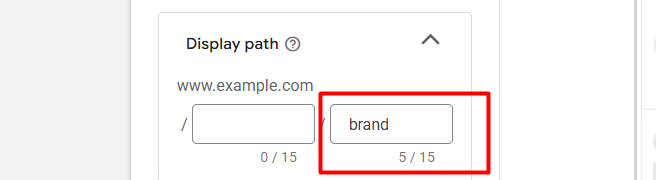
If you want, you can use your competitors’ brand names in the second-level domain of your ad’s display URL.
Interestingly, even if your competitor has a trademark on their brand name, no problem; you can still use their name in this specific part of the display URL. This is legal according to Google’s rules and does not pose a risk of policy violation.
Ad copy mention
If you want, you can also use the names of competitors in the main text or ad copy of your ad. Technically, Google allows this. However, there is one big condition here—your ad should not be deceptive or misleading in any way.
That is, people should not think that you are actually part of that brand or that your product is made by them. You can use it to provide comparisons or information in a simple and transparent way.
Resellers
Also, if you are a reseller of a particular brand of product, then you can easily use that brand name in your advertisements.
In fact, this is the safest way to use a brand name in the Google ads copy. However, in this case, resellers have to take a pre-authorization from the original brand.
Then, before starting the campaign, they have to submit all the necessary documents and certificates to Google. If you follow this process correctly, you can easily and safely use trademarked names in your advertisements.
Problem With Trademark Policy
However, don’t forget that if you do not follow these rules correctly, you will have to suffer with a lot of different losses. The problem actually arises when you use another brand’s name in your ad copy without permission or in a misleading way. If you do this, that brand can directly complain to Google against you.
Moreover, many companies submit their brand’s trademark license to Google in advance so that no one can misuse their name. As a result, whenever you try to advertise using their name, Google will immediately consider it as your policy violation and will not allow your ad to run.
If you do not follow the correct rules, you can basically face these 3 major problems:
- Ads Disapproval: Google will cancel your ad.
- Account Suspension: Your entire Google Ads account may be closed permanently due to repeated mistakes.
- Legal Issues: In some cases, you may also have to face legal complications or lawsuits.
Suggestion From our side
Finally, my advice is to avoid using competitors’ names in your Google ad copy. This should only be done if you are a recognized reseller of that brand and have the necessary permission. Otherwise, even a small mistake can cost you a lot of money.
Yes, you can use competitors’ names in your keyword list without any worries. But always remember one thing: never use dynamic keyword insertion in your ad if your list includes competitors’ names. This can automatically result in their names appearing in your ad copy, which can get you into major legal or policy trouble.
So using competitor brand names in your Google Ads campaigns is a very powerful strategy, if you know the right rules. As easy and safe as using names in your keyword list is, it is just as sensitive when it comes to ad copy. So it is wise to use them as keywords to increase your brand awareness, but not to take risks with your ad copy. Remember, following the right data and policies is the key to your ad’s success.
If you have any more questions on this topic or need any help with your campaign setup, you can comment below or send me a direct message. Good luck with your next campaign!